
How the forecasts work
DiveSight gives you two forward-looking forecasts for a dive site: how active the marine life is likely to be, and what the visibility is likely to be. Here is the thinking behind them, in plain terms.
We forecast the difference from normal
Any app can tell you that a tropical reef is usually clear in summer, or that a well-known site usually teems with fish. That is just the seasonal average, and generic dive guides and forecasts often capture those basic levels, which require no real prediction.
The part that actually helps you decide where and when to dive is knowing when a specific place, in a specific week, will be different from its own norm: clearer than usual or murkier, busier with life or quieter. That difference is what DiveSight is built to predict. Every forecast is anchored to what is normal for that exact site at that time of year, and then it tells you which way the coming window is leaning.
It reads recent conditions, not just the calendar
A seasonal average only knows the date, such as the statement “this area tends to have calmer seas and better visibility during summer months”. DiveSight incorporates these seasonal signals but also takes in a wide range of environmental signals that fluctuate on a daily or hourly basis, such as the state of the water at various depths and the weather shaping it in the days leading up to your dive. Conditions can often have momentum. A storm several days earlier hundreds of miles away can still be stirring up a site today, and a settled spell can calm the water and draw life in. Reading that recent history is what separates a forecast from an average.
Two forecasts, each anchored to the site
DiveSight provides two forecasts of central interest to divers.
Marine life activity
Whether fish and other life are likely to be more or less active than is typical for that site and season.

Visibility
What the underwater visibility is likely to be relative to what the site usually offers.
Both are read against the site’s own baseline, so “better than usual here” means exactly that, for that place. The two forecasts answer to different forces. Here is what shapes each, and why.
What shapes visibility
Underwater visibility comes down to how light interacts with what is suspended in the water between you and whatever you are trying to see. Tiny particles, mostly drifting plankton, stirred-up sediment, and organic matter, scatter and absorb light, so the more of them in the water, the less far you can see. Many forces decide how much is suspended at any moment, and how fast it clears.
Light
How far you can see depends on how much light is available. Overcast skies, a low sun, and early or late dives all cut visibility even when the water itself is clear.
Depth
The surface layer is generally the noisiest, with glint, chop, and runoff sitting on top, while deeper water tends to be more settled. Visibility near the surface and visibility at depth can be quite different on the same dive.
Waves, swell, and storms
Wave energy lifts sediment off the bottom and mixes the water column. A storm several days earlier can still be clouding a site today, and shallow, sandy sites feel it most.
Currents and tides
Moving water can flush a site clean by drawing in clear oceanic water, or drag in murkier water from elsewhere. At many sites the tide is the difference between a clear and a cloudy dive, depending on whether it is pulling ocean water in or estuary water out.
Wind
Sustained wind builds chop and waves, stirs the surface, and can push cloudy surface water across a site.
Plankton
The same blooms that feed marine life also cut clarity. Rich, productive water is often greener and shorter on visibility, which is why the clearest water and the most life do not always line up.
Runoff after rain
Rivers, and even small coastal creeks, carry sediment and nutrients to the sea after heavy rain, and the resulting plume can cloud nearshore water for days. A clear site can turn murky well after the rain has stopped.
Local geography
The shape of a site decides how much of all this actually reaches it. A sheltered cove, a deep wall, or a reef that blocks the swell can hold visibility when exposed sites nearby blow out, while a shallow, sandy bottom near a river mouth muddies easily and clears slowly. Two sites a short distance apart can dive completely differently because of how each sits relative to land, depth, and the open ocean.
This is exactly the kind of problem DiveSight is built for: its models learn from years of satellite and ocean data how these forces interact at each individual site, and carefully weigh them together into a single forecast. By combining high-resolution satellite data at the daily and hourly level to understand how conditions like these compare against what each site normally offers, the forecast reflects each specific place, not a generic average.
What shapes marine life
Marine life abundance and activity are also driven by many factors, and small shifts in them can change a dive from quiet to charged. None of these forces acts alone, though. They overlap, reinforce, and sometimes cancel each other out, and animals do not always follow the rules. That interplay is what makes marine life genuinely hard to predict, and why we treat it as a forecast rather than a promise.
Light and the daily clock
Most reef predators hunt hardest at dawn and dusk, when low light favors the hunter over the hunted. Midday sun with strong light sends many reef fish to shelter, while nocturnal hunters wait for dark. The time of day you drop in shapes what you are likely to see.
Tides
Tidal flow opens and closes feeding windows. Ambush hunters such as groupers and moray eels, and the reef predators that work the flow, time their activity to the water that sweeps prey past them. The same site can switch from sleepy to active as the tide turns.
Food at the base of the web
When the water turns productive and plankton multiply, the effect ripples upward. Drifting plankton pull in filter feeders and baitfish, and the baitfish pull in predators. Productive spells are often the busiest diving, even when the water is a little greener for it and visibility is lessened.
Temperature
Every species has a comfort range. A shift of a couple of degrees can move fish into or out of an area, trigger spawning, or change how actively animals feed. Warm pushes and cold upwellings reshuffle who is around.
Currents
Moving water delivers food and oxygen and sets up the gathering points divers seek out. Many big-animal encounters happen where a current meets structure, a wall or a point, where sharks, jacks, and other open-water hunters hold and feed. Slack water and running current can sometimes feel like different dives.
The structure of the water column
Where warm surface water meets cooler water below, plankton and the animals that feed on it concentrate along that boundary, and predators patrol the edge. It is one reason life often stacks up at particular depths rather than spreading evenly.
Local geography
Structure concentrates life. Walls, pinnacles, drop-offs, and healthy reef give animals places to shelter, hunt, and gather, so a current-swept point can teem while open sand nearby stays quiet. Sites near deep water or upwelling tend to see more big animals, and the more complex the terrain, the more there is to find.
Season tells you what’s roughly possible or generally expected at a site. Migrations, aggregations, and spawning events often follow the solar calendar or lunar cycle. But it’s these day-to-day conditions, and the way they interact, that tell you how the current week actually compares.
We test against reality, not against ourselves
It is easy for a model to look good by repeating the averages it learned. We used a much stricter benchmark and measured something harder: how much the forecasts beat the seasonal average for a given place. Beating the average is exactly what makes a forecast worth having; that gap is the whole point. The seasonal average tells you what a site is typically like at this time of year (which is why we provide these data to you as well); the forecast tells you how the coming week is actually shaping up against that, and that is the part that informs whether it is worth going now or waiting.
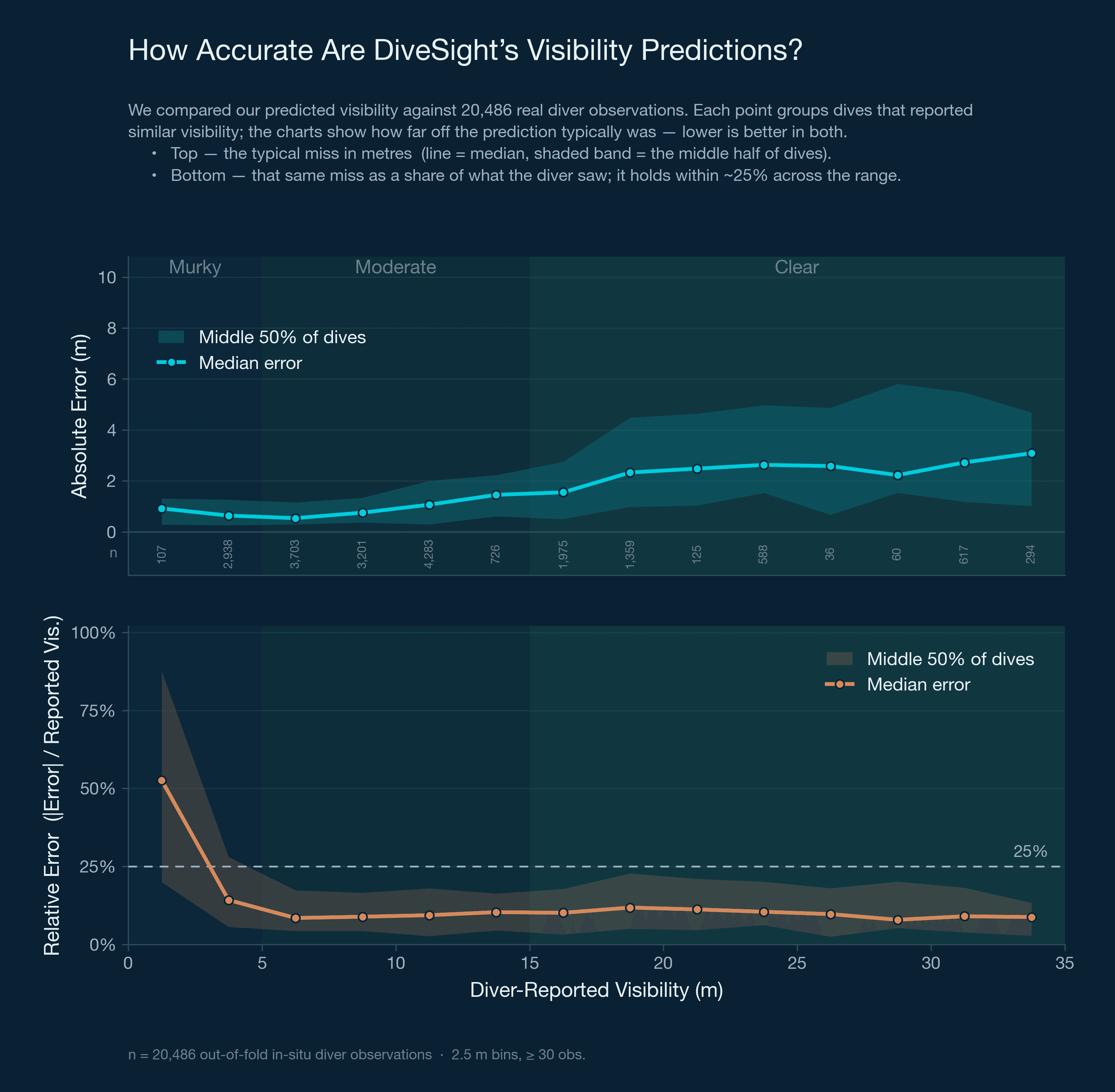
How do we know how good our forecasts are? We scored our models only on real observations, collected by trained human divers, which the models had never seen while they were being built. This provides a rigorous way to know how accurate our forecasts will be on new days the model hasn’t seen data from before — the days that you want to go diving this week.
Share of above-typical calls that prove correct, scored only on held-out observations from trained divers the models never saw in training.
Visibility accuracy
We think the most intuitive way to understand the value of our forecasts is to answer the following question: when the forecast says conditions are better than typical for a site, what percentage of the time are they right? This number tells you how confident you can be that visibility will be better than normal on a particular day.
For visibility, this number is 85% on average. In other words, if the forecast says a dive site will have better visibility than average, there is an 85% chance visibility will actually be better. One useful thing to keep in mind is that if the visibility forecast says “excellent” (the highest category), it is more likely than 85% to be particularly clear. And if it’s just “good”, one step above “average”, then the forecast is a bit less likely to be accurate, but should still be correct nearly 8 times out of 10. The reason for this difference is that it’s harder for any model to identify smaller changes from baseline as compared to larger ones (this is a general property of statistical tests). This tendency is one reason why we think it’s more intuitive to think about the overall direction of the forecast relative to typical: it provides a valuable overall picture of how good things are likely to be.
Marine life accuracy
The marine life abundance forecasts are in the same ballpark but slightly less accurate (living creatures behave even less predictably than ocean particulates!). But even here our model delivers strong results.
When the forecast says a dive site will be better than average, the model is right 75% of the time. If it tells you the day is “excellent” specifically, marine life should be noticeably abundant (if you know what normal is like there) 80% of the time. If it tells you the day is “poor” (again, relative to that site’s seasonal norm), that number will be right 87% of the time. (Fish more reliably move away from bad conditions than appear in great ones.)
Both forecasts add real, measurable value beyond a historical average or common wisdom about how a place is in a given season. The visibility forecast lines up strongly with what divers actually report across thousands of sites worldwide. And when the marine life forecast flags a site as unusually good or unusually poor, the dive lands on that side roughly eight times in ten, well above the even odds of a guess.
A forecast is a tendency, not a promise
The ocean is delightfully complex, and any single dive can surprise you (or the models). DiveSight tells you which way the odds are leaning for a site and a week, not what will certainly happen, and we word the forecasts that way on purpose. And when conditions point to an unusually good or unusually poor window, that is a particular signal worth planning around.
Making our forecasts even better — together
Every forecast is measured against what divers actually see in the water, so logging your dives is the best way to make them better, especially when you record visibility and the marine life you saw. DiveSight’s dive log feature provides the ability to enter visibility and marine life with a single click each. We deliberately made this as easy and quick as possible because these are real ground truth from a real dive, the same kind of data the models learn from, and they sharpen the forecast most at the sites you return to. And the more divers log what they find, the better it gets for everyone. Our mission is to make these models as accurate as ocean dynamics allow. Your dive logs provide one very important way to accelerate that outcome.
Your marine life logging efforts also do double-duty: if you link your DiveSight account with your iNaturalist account, every species observation you record with a photo automatically enters, once verified, the global biodiversity records. Your dive logs become not just a way to store memories, but a way to contribute to ocean science and conservation.